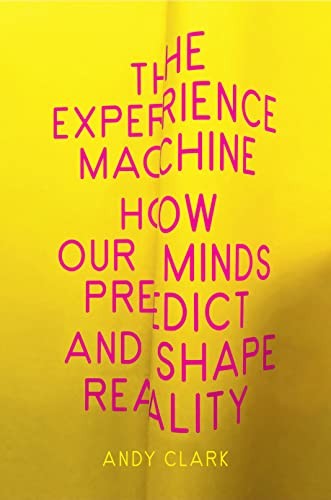
For as long as we’ve studied human cognition, we’ve believed that our senses give us direct access to the world. What we see is what’s really there—or so the thinking goes. But new discoveries in neuroscience and psychology have turned this assumption on its head. What if rather than perceiving reality passively, your mind actively predicts it?
Widely acclaimed philosopher and cognitive scientist Andy Clark unpacks this provocative new theory that the brain is a powerful, dynamic prediction engine, mediating our experience of both body and world. From the …
For as long as we’ve studied human cognition, we’ve believed that our senses give us direct access to the world. What we see is what’s really there—or so the thinking goes. But new discoveries in neuroscience and psychology have turned this assumption on its head. What if rather than perceiving reality passively, your mind actively predicts it?
Widely acclaimed philosopher and cognitive scientist Andy Clark unpacks this provocative new theory that the brain is a powerful, dynamic prediction engine, mediating our experience of both body and world. From the most mundane experiences to the most sublime, reality as we know it is the complex synthesis of sensory information and expectation. Exploring its fascinating mechanics and remarkable implications for our lives, mental health, and society, Clark nimbly illustrates how the predictive brain sculpts all human experience. Chronic pain and mental illness are shown to involve subtle malfunctions of our unconscious predictions, pointing the way towards more effective, targeted treatments. Under renewed scrutiny, the very boundary between ourselves and the outside world dissolves, showing that we are as entangled with our environments as we are with our onboard memories, thoughts, and feelings. And perception itself is revealed to be something of a controlled hallucination.
Unveiling the extraordinary explanatory power of the predictive brain, The Experience Machine is a mesmerizing window onto one of the most significant developments in our understanding of the mind.
It's a well-written introduction into predictive processing as a key feature of human cognition. This is a framework that got me very excited in the early 2010s and I still believe it offers very deep insights into what cognition is (and more speculatively, how it probably arose).
Yet in the end the book did not do much more for me than provide an entertaining read. If you want a crash course on the predictive mind (with some excursions into the extended mind), then do pick up this book. If you're already relatively informed about the topic, there may not be enough on display here.